Navigating UK Business Visa in 2026
The United Kingdom remains one of the world’s most active destinations for international business travel, corporate expansion, and entrepreneurial ventures. Whether you are attending a meeting in London for a few days, establishing a new UK branch, or transferring employees to a British office, securing the correct permission to enter and operate in the UK is more critical than ever.
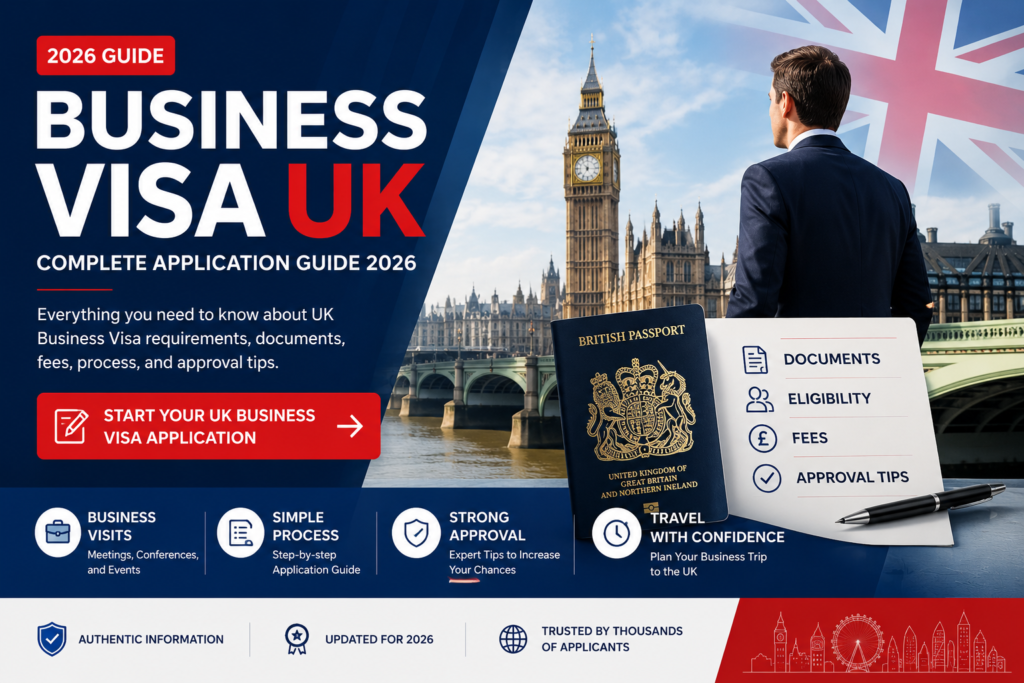
UK Business Visa in 2026
The United Kingdom remains one of the world’s most active destinations for international business travel, corporate expansion, and entrepreneurial ventures. Whether you are attending a meeting in London for a few days, establishing a new UK branch, or transferring employees to a British office, securing the correct permission to enter and operate in the UK is more critical than ever.
The term “business visa” is a broad one. The UK does not have a single designated business visa; instead, it provides multiple immigration routes tailored to different commercial activities, from short-term visits under the Standard Visitor route to long-term corporate transfers via the Global Business Mobility framework. Selecting the wrong category can lead to refusals, entry bans, or legal consequences for your business.
This complete 2026 guide explains each visa type, details the most recent fee increases effective April 2026, clarifies the new Electronic Travel Authorisation (ETA) requirements, provides a step-by-step application process, and highlights the permitted and prohibited activities that all business travellers must know.
2026 Key Updates at a Glance (What’s Changed)
Before diving into the details, it is essential to understand the major changes affecting business visa applicants in 2026:
- Fee Increases (from 8 April 2026): Most visa fees, including visitor, work, and Global Business Mobility routes, have increased by approximately 6–7%.
- ETA Mandatory for All Non-Visa Nationals (from 25 February 2026): All travellers without existing visa-free status, including EU, US, and Australian citizens, now require an Electronic Travel Authorisation before boarding a flight to the UK.
- Higher English Language Requirement for Some Routes: Certain business routes now require CEFR Level B2 (Upper-Intermediate) English proficiency.
- Updated Business Visitor Rules (Appendix V): The Home Office has issued further guidance clarifying permissible business activities and has aligned the rules with the new ETA system.
- Increased Salary Thresholds for GBM Routes: The minimum salary for Senior or Specialist Worker and UK Expansion Worker routes has increased to £48,500 (or higher going rate) with a £52,500 threshold for certain senior roles.
Types of UK Business Visas
The correct visa type depends entirely on your business activity, length of stay, and intention regarding employment in the UK.
1. Standard Visitor Visa (for Business Purposes)
This is the most common entry route for short-term business travel. It is designed for overseas professionals coming to the UK for up to six months to engage in permitted business activities without joining the UK labour market. It does not allow paid work for a UK entity.
Maximum stay: 6 months (or up to 12 months for academics on sabbatical). Long-term visitor visas are available for 2, 5, or 10 years, but each individual visit must not exceed 6 months.
Permitted activities: Attending meetings, conferences, and seminars; negotiating or signing contracts and deals; conducting site visits and inspections; gathering information for an overseas business; and undertaking specific internal training with a UK branch of the same corporate group.
Who can apply: Most nationalities can apply online from outside the UK. Non-visa nationals (such as US and EU citizens) were previously exempt from applying in advance, but under the 2026 ETA system, they must now obtain digital pre-authorisation before travel.
2. Global Business Mobility (GBM) Visa
The GBM umbrella route replaced the old Intra-Company Transfer system and provides five distinct pathways for international businesses to send workers to the UK on temporary assignments. Most GBM routes do not lead to settlement (Indefinite Leave to Remain), with limited exceptions for senior workers under specific circumstances.
GBM routes include:
- Senior or Specialist Worker: For multinational employees being transferred to a UK branch, subsidiary, or parent company. Requires a Certificate of Sponsorship (CoS) and a minimum salary of £48,500 (or the going rate, whichever is higher). Maximum stay: 5 years (9 years for high earners).
- Graduate Trainee: For employees on structured graduate training programmes being transferred to the UK as part of that programme. Minimum salary: £24,220. Maximum stay: 1 year.
- UK Expansion Worker: For workers being sent to the UK to help establish a new UK branch or subsidiary of an overseas business that has no active UK presence yet. Minimum salary: £48,500. Maximum stay: 2 years.
- Service Supplier: For workers supplying services to a UK business under a contract, provided the UK and the overseas country have a relevant trade agreement (such as CPTPP or the UK-India Free Trade Agreement).
- Secondment Worker: For overseas employees being seconded to a UK business as part of a high-value contract or investment arrangement worth at least £50 million. Maximum stay: 2 years.
3. Innovator Founder Visa
Aimed at experienced entrepreneurs launching an innovative, viable, and scalable business in the UK. This route requires an endorsement from an approved UK endorsing body and a robust business plan. Unlike most GBM routes, the Innovator Founder Visa can lead to settlement.
4. Global Talent Visa
For leaders or potential leaders in digital technology, arts and culture, science, engineering, social sciences, humanities, and medicine. Applicants must be endorsed by a recognised UK body. This route permits self-employment and working without a sponsoring employer.
5. High Potential Individual (HPI) Visa
A short-term work visa for recent graduates of top global universities (those listed in recognised global rankings). Applicants do not need a job offer or sponsorship. The visa allows work, job-seeking, self-employment, and voluntary activities.
Eligibility and Key Requirements for 2026
While each visa route has specific criteria, all business visa applicants must satisfy several core requirements.
| Requirement | Standard Visitor (Business) | GBM Routes | Innovator Founder |
| Valid Passport | Required | Required | Required |
| Sponsor/Certificate of Sponsorship | Not required | Required | Not required (endorsement needed) |
| Financial Self-Sufficiency | Must prove | Must prove | Must prove |
| English Proficiency | Not required | B1 (some routes) | B2 (from 2026) |
| Endorsement from UK Body | Not required | Not required | Required |
| Business Plan | Not required | Not required | Required |
| Maximum Stay | 6 months | 1–5 years (depending on route) | 3 years (renewable) |
| Pathway to Settlement | NO | No (except limited Senior Worker) | Yes |
Financial Self-Sufficiency: Applicants must demonstrate they can support themselves without relying on public funds. This typically involves showing personal bank statements (usually covering the most recent six months) with sufficient funds to cover accommodation, travel, and living costs.Get more details here
English Language Proficiency: From 2026, applicants on many business and work routes must demonstrate English language ability at CEFR Level B1 (Intermediate) or B2 (Upper-Intermediate) for certain categories, depending on the route and whether settlement is sought. This is generally evidenced by an approved Secure English Language Test (SELT) certificate, an academic degree taught in English, or by being a national of a majority English-speaking country.
Criminality and Compliance: All applicants must not have serious criminal convictions and must not have previously breached UK immigration rules (including overstaying, working without permission, or submitting false documents).
Genuine Visitor Requirement (Visitor Route): Under Appendix Visitor, visa officers carefully assess whether applicants genuinely intend a temporary visit and will leave at the end of their stay. Officers examine travel history, financial circumstances, overseas employment ties, and personal links outside the UK.
Step-by-Step Application Process
The application process varies slightly depending on whether you are applying from outside or inside the UK and which visa route you are using. The steps below cover the most common scenario: applying for a UK Business Visitor Visa from overseas.
Step 1: Determine the Correct Visa Route
Identify which visa category corresponds to your business purpose and length of stay. Choosing the wrong route is one of the most common reasons for refusal.
Step 2: Complete the Online Application Form
Visit the official UK government visa application portal (gov.uk) and complete the relevant application form. For business visitors, this is typically the Standard Visitor Visa application. For GBM routes, you will need to reference your Certificate of Sponsorship (CoS) number provided by your UK sponsor.
Step 3: Pay the Application Fee and Immigration Health Surcharge (if applicable)
Pay the applicable visa fee using a debit or credit card. Some routes (such as GBM and Innovator Founder) also require payment of the Immigration Health Surcharge (IHS) for access to the UK’s National Health Service. The IHS is charged at £1,035 per year for most adults.
Step 4: Book and Attend a Biometric Appointment
After submitting the online form, you will be directed to book an appointment at a Visa Application Centre (VAC) in your country. At the appointment, you will provide fingerprints and a photograph. Some nationalities may be eligible to use the UK Immigration: ID Check smartphone app instead of attending an in-person appointment.
Step 5: Submit Supporting Documents
Upload or present the required supporting documents (list provided below). Ensure all documents are translated into English by a certified translator if they are not originally in English or Welsh.
Step 6: Await a Decision
Standard processing from outside the UK is approximately 3 weeks (15 working days). During busy periods or for complex cases, processing may take 4–6 weeks. You will be notified when a decision has been made.
Required Visa Documents Checklist (2026)
A complete and well-organised document package is critical for a successful application. UKVI does not assess documents purely formally; each file is reviewed in the context of the trip purpose, the applicant’s business status, and the overall immigration logic.
Core Documents for All Business Visas:
- Valid passport: Must be valid for the entire duration of the intended stay and have at least one blank page for the visa sticker (if issued).
- Completed visa application form: Printed confirmation of your online application.
- Recent passport-sized photographs: Meeting UK visa photo requirements (two copies usually required).
- Biometric appointment confirmation: Evidence that you have enrolled your fingerprints and photograph.
Business-Specific Supporting Documents (Essential for Visitor Route):
- Invitation letter from a UK business partner or host organisation: Must clearly describe the purpose of the visit, the proposed activities, and the itinerary. Template invitations without specific details are a common reason for refusal.
- Letter from your overseas employer: Confirming your position, length of employment, salary, and that you will continue to be employed and paid outside the UK.
- Meeting agenda or conference schedule: A detailed itinerary demonstrating that your activities align with permitted business activities under Appendix Visitor.
- Bank statements: Covering at least the most recent six months, showing a consistent pattern of income and sufficient maintained balance to cover your stay.
- Evidence of ties to home country: Property ownership, family ties, or ongoing employment contracts to demonstrate that you will not overstay.
- Travel itinerary and accommodation details: Pre-booked flights and hotel reservations (where applicable).
Additional Documents for GBM Routes:
- Certificate of Sponsorship (CoS) reference number: Issued by your UK sponsor.
- Employment contract and payslips: Demonstrating the employment relationship with the overseas company for the required period (usually 12 months, unless the salary exceeds £73,900 per year).
- Evidence that salary meets the going rate for the SOC occupation code: The 2026 going rate for many senior roles is set at £52,500 per year.
- Employer confirmation of the assignment: Including start and end dates of the temporary UK assignment.
Additional Documents for Innovator Founder Visa:
- Endorsement letter from an approved UK endorsing body.
- Comprehensive business plan: Describing how the business is innovative, viable, and scalable.
- Evidence of funds for business establishment (usually at least £1,270 for maintenance).
Processing Visa Times and Priority Services
Standard Processing Times (2026)
| Application Type | Standard Processing (outside UK) | Standard Processing (inside UK) |
| Visitor Visa (including business) | 3 weeks (15 working days) | N/A (must apply from outside |
| Skilled Worker (including GBM routes) | 3 weeks | 8 weeks |
| Innovator Founder Visa | 3 weeks | 8 weeks |
| Global Talent Visa | 3 weeks | 8 weeks |
| Family/Business (complex cases) | Up to 12 weeks | Up to 8 weeks |
Processing times are counted from the date UKVI receives your biometric information, not from the date you submit the online form. During peak seasons (typically July to September), processing may extend to 4–6 weeks.
Priority and Super Priority Services (Faster Decisions)
For urgent business travel, UKVI offers priority services subject to availability and additional fees:
- Priority Service: Decision within 5 working days (from biometrics). Additional fee: £500.
- Super Priority Service: Decision by the end of the next working day (subject to availability and if appointment times permit). Additional fee: £1,000.
Permitted Activities vs Prohibited Work (Crucial for Visitor Visa)
One of the most common reasons for visa refusal or entry refusal at the border is misunderstanding what constitutes “permitted business activity” versus what crosses the line into “prohibited work.”
Permitted Business Activities (Visitor Route)
Business visitors may carry out the following activities provided they remain employed and paid outside the UK and do not fill a UK labour market role:
- Attending meetings, conferences, seminars, and interviews.
- Negotiating and signing contracts and business deals.
- Conducting site visits, inspections, and tours of UK premises.
- Gathering information for overseas employment or business.
- Providing training to UK staff where the visitor remains an employee of the overseas company (intra-corporate training).
- Participating in trade fairs for promotional purposes only (not selling directly to the public).
- Remote working (limited): Answering emails or taking calls related to your overseas job is permitted, provided this is not the primary reason for the visit.
Prohibited Activities (The “Work” That Will Get You Refused)
Border Force and UKVI officers are trained to identify the following as prohibited activities. If any of these are suspected, entry will be refused, and you may face a 10-year travel ban for deception.
- ❌ Taking paid employment for a UK company or organisation.
- ❌ Doing work for a UK organisation or business, even if unpaid (e.g., filling a role that a UK resident could perform).
- ❌ Establishing or running a business as a self-employed person in the UK.
- ❌ Undertaking a work placement or internship at a UK company.
- ❌ Directly selling goods or providing services to the UK public.
- ❌ “Productive work” that supplies labour to a UK customer or client (e.g., coding, consulting, managing UK staff).
Frequently Visa
Asked Questions
If you are a national of a visa-required country, yes. You must apply for a Standard Visitor Visa before travelling. If you are a national of a non-visa country (such as the US or EU member state), you do not need a visa for a one-day business meeting, but from 25 February 2026 you do need an ETA. All travellers, regardless of visa status, must comply with permitted activities.
A Business Visitor Visa is for short, infrequent trips (maximum 6 months) for meetings, conferences, and negotiations. You cannot be paid by a UK company or fill a UK role. The GBM Senior or Specialist Worker Visa is for longer, temporary assignments where the worker is transferred to a UK branch of their multinational employer, is paid (generally by the overseas parent company, but may receive UK allowances), and is sponsored by a UK entity with a valid sponsor licence.
Yes, limited remote working is permitted. You may answer emails and join calls relating to your overseas job, provided this is not the primary purpose of your visit. If your sole or main reason for travelling is to work remotely from a UK hotel while keeping your foreign salary, you risk having your visit classified as “living in the UK by frequent visits,” which may lead to refusal of future entry.
Standard visitor visas from outside the UK take approximately 3 weeks (15 working days) from biometric enrolment. Priority service (5 working days) and Super Priority (next working day) are available for an additional fee, subject to availability
If refused, you will receive a formal refusal notice explaining the reason (e.g., insufficient evidence of business purpose, concerns over prohibited work, lack of financial funds). You may be able to submit a fresh application addressing the reasons for refusal. Limited rights of administrative review are available for certain visa categories. For visitor visas, administrative review is not usually available; a new application with stronger evidence is typically required.
No. You generally cannot switch from a Standard Visitor Visa (including business visitor) to any work or long-term visa from inside the UK. You must leave the UK and apply from your home country.