
IELTS UKVI 2026: Computer vs Paper. What UKVI Applicants Must Know
Big changes are coming to IELTS in 2026. If you’re applying for a UK visa, work permit, or student route, understanding the shift from paper-based to computer-delivered IELTS could save you time, money, and stress.
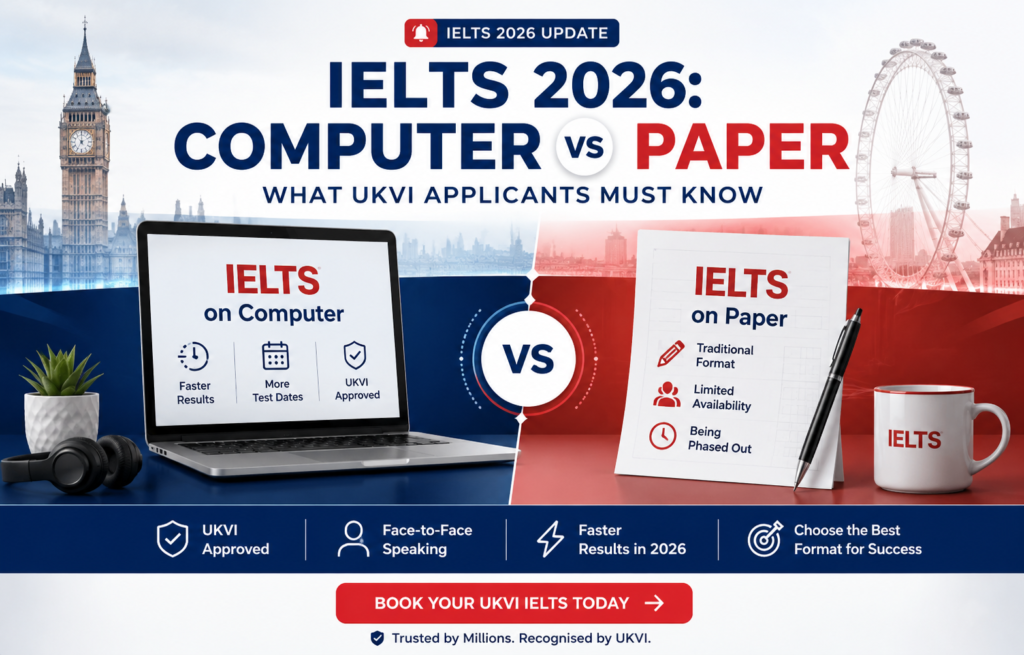
The Biggest Change to IELTS UKVI in a Decade
If you’re planning to take IELTS for UK Visa and Immigration (UKVI) purposes in 2026, there’s a critical change you need to understand before you book your test.
After years of offering both formats side by side, IELTS is making a historic shift. From mid-2026, paper-based testing will be phased out globally, and all IELTS tests – including the UKVI version – will be delivered on computer. This isn’t a distant rumour or a minor policy tweak; it’s a definitive change that affects every test taker. Whether you’re a confident typist or someone who has always preferred the comfort of a pen, you need a clear plan to navigate this new landscape successfully.
This guide will walk you through everything UKVI applicants must know: the crucial deadlines you cannot afford to miss, a detailed head-to-head comparison of the two formats, the new ‘Writing on Paper’ hybrid option, and a practical action plan to ensure you’re fully prepared.
Computer vs Paper
While the content, difficulty, and scoring of IELTS remain identical regardless of the format, the test-day experience differs significantly. Here’s a breakdown of what you can expect from each section.
Listening
Paper: You listen through headphones and write your answers directly on the test paper. After the audio finishes, you are given 10 minutes of extra time to transfer your answers to the official answer sheet. This extra time is a major advantage for those who like to jot down notes or verify their spelling.
Computer: You listen through headphones and type (or select) your answers directly into the computer interface. There is no 10-minute transfer time; you get only 2 minutes at the end to review your answers. This means you must complete your answers as you listen, requiring quick and accurate typing skills.
Reading
Paper: You receive a traditional paper booklet. You can underline keywords, circle important information, flip between pages quickly, and make notes in the margins – a physical experience that many find reassuring and intuitive.
Computer: The screen is split into two panes: the passage on the left and the questions on the right. This eliminates the need for constant flipping. You can highlight text and add notes digitally, but these functions operate differently than on paper. For gap-fill questions, you can copy and paste words directly from the passage – a feature that helps avoid spelling errors but requires familiarity with keyboard shortcuts.
Writing
Paper: You handwrite two essays (Task 1 and Task 2). You must keep track of word count manually, and any mistakes require erasing or crossing out, which can affect the presentation. This format suits test takers who write neatly and confidently by hand.
Computer: You type your essays directly into the system. The software shows a live word count, allows you to cut, copy, and paste text, and makes editing effortless. For fast typists with good keyboard skills, this can significantly improve writing efficiency and reduce anxiety around word limits. However, if you’re a slow or inaccurate typist, it can become a serious disadvantage.
Speaking
The Speaking test remains largely unchanged – and that’s good news. Both formats still involve a face-to-face conversation with a trained IELTS examiner. In some test centres, this may be conducted via secure video call, but the content, timing, and scoring are identical.
UKVI-Specific Update: Your Definitive Timetable
This is where you need to pay attention. The timeline for phasing out paper tests varies by country and by test type. For UKVI applicants, the deadlines are earlier than for standard IELTS.
According to official announcements, the paper-based IELTS for UKVI will be fully discontinued from 22 March 2026, with all UKVI tests delivered on computer thereafter. Additional regional deadlines are as follows:
| Mainland China | IELTS for UKVI paper-based tests will cease from 1 July 2026. |
| Iraq | The last paper-based IELTS for UKVI test was held on 14 February 2026. |
| Bangladesh | UKVI IELTS moved to computer-only from the second half of 2025. |
| Taiwan (China) | All IELTS paper tests ended on 31 January 2026. |
What does this mean for you? If you are required to take the UKVI version for a visa application, you should assume that paper-based UKVI tests are either already unavailable or will become unavailable very soon in your region. The window for paper-based UKVI testing is closing rapidly, and in many locations, it has already closed.
The ‘Writing on Paper’ Hybrid Option: An Important Distinction
One of the most significant details introduced in 2026 is the ‘Writing on Paper’ option. Understand this correctly, or you could make a costly mistake.
The ‘Writing on Paper’ option allows you to take the Listening and Reading sections on computer (receiving the speed and flexibility benefits of the digital format) but handwrite your Writing section responses. This is designed as a bridging solution for test takers who are confident with computers but strongly prefer handwriting essays.
Critical for UKVI applicants: As things stand, the ‘Writing on Paper’ option is NOT available for IELTS for UKVI tests at this time. For UKVI purposes, you must take the full computer-based test, including typed writing responses. Do not assume you can select this hybrid option when applying for your UKVI test.
For standard IELTS test takers, the ‘Writing on Paper’ option provides a genuine pathway to combine the best of both worlds. For UKVI candidates, it remains an important distinction that you must factor into your preparation strategy.
Practical Advantages of Computer-Based Testing
Given that UKVI applicants will soon have no choice but to take the computer-based test, it’s worth focusing on the genuine advantages this format brings:
- Results are significantly faster. Computer-based test takers typically receive their scores within 1 to 5 days, compared to 13 days for paper-based results. For applicants facing tight visa deadlines or university offer conditions, this speed can be a lifeline.
- Test scheduling is more flexible. Computer-based tests are offered much more frequently – often multiple times per week and at various times of day. Registration can be completed as late as a day before the test, providing last-minute flexibility that paper tests never offered.
- The One Skill Retake feature is available for computer-based tests. If you perform poorly in just one section, you can retake that single skill rather than resitting the entire exam.
Which Format Is Right for You?
With the transition underway, your choice depends heavily on your timeline. Here is a straightforward decision framework:
If you must take the UKVI test and you are currently in a region where paper-based UKVI tests are still available (check your local test centre immediately), you have a genuine choice.
- Choose paper if you strongly prefer handwriting, struggle with typing speed, and feel more confident with physical marking and extra transfer time for listening.
- Choose computer if you are comfortable typing, want faster results, and appreciate the scheduling flexibility digital tests provide.
However, if you are planning to take the UKVI test after the paper-based deadline in your region (for most candidates, this means after early to mid-2026), your choice is effectively made for you. Computer-based testing will be your only option.
For those in the latter position, do not panic. The test content remains identical. Your task is to shift your preparation strategy to focus on building digital test-taking skills.
Your 2026 Action Plan
With the IELTS landscape changing decisively in 2026, here is a practical action plan to ensure you are ready:
- Check your local deadline immediately. Find out whether paper-based UKVI tests are still available in your country and when the final date is. Book early if you need the paper format.
- Take official computer-based practice tests. IELTS provides free scored practice tests in the computer format. Use these to familiarise yourself with the interface, the split-screen reading layout, and the typing requirements for writing.
- Build your typing speed. If you are not already comfortable with keyboard typing, dedicate time to practice. Aim for at least 30–40 words per minute with reasonable accuracy to avoid feeling rushed during the writing section.
- Practice listening without the extra transfer time. Simulate the computer-based listening environment by giving yourself only 2 minutes to transfer answers after the audio finishes. This will train you to answer while listening.
- Confirm the latest UKVI ‘Writing on Paper’ policy. This option is evolving. Check the official IELTS website for your region before making any final decisions about which format to book.


it was helpful thanks